How to Choose the Best 3D Printing Service?

Choosing the best 3 D Printing service starts with the part you need, not the machine a provider advertises. A prototype for checking fit has different needs from a finished component that must handle repeated use. The right provider should explain which materials and processes suit your design, along with their limits. A confident promise is not a substitute for clear specifications.

Compare more than the quoted price. Check minimum wall thickness, dimensional tolerances, surface finish, and whether the service reviews files before production. Ask for material data sheets or sample parts when performance matters. A useful quote should state the material, process, expected lead time, and any finishing costs. Details matter. So does communication. A provider that flags a thin feature or unsupported overhang may help you avoid a failed print, but confirm proposed design changes before approving them.

Look for relevant experience, documented quality checks, and examples of similar work. Reviews can help, but they may not describe your part’s exact requirements. If the project is important, order a small test piece and measure it against your drawing. That adds time and cost. It can still reveal problems early. No single service is best for every design, and online comparisons leave gaps. Ask specific questions, keep the approved file version on record, and judge the response as carefully as the price. I would not treat a polished website as proof of consistent results; actual tolerances and repeatability need checking.
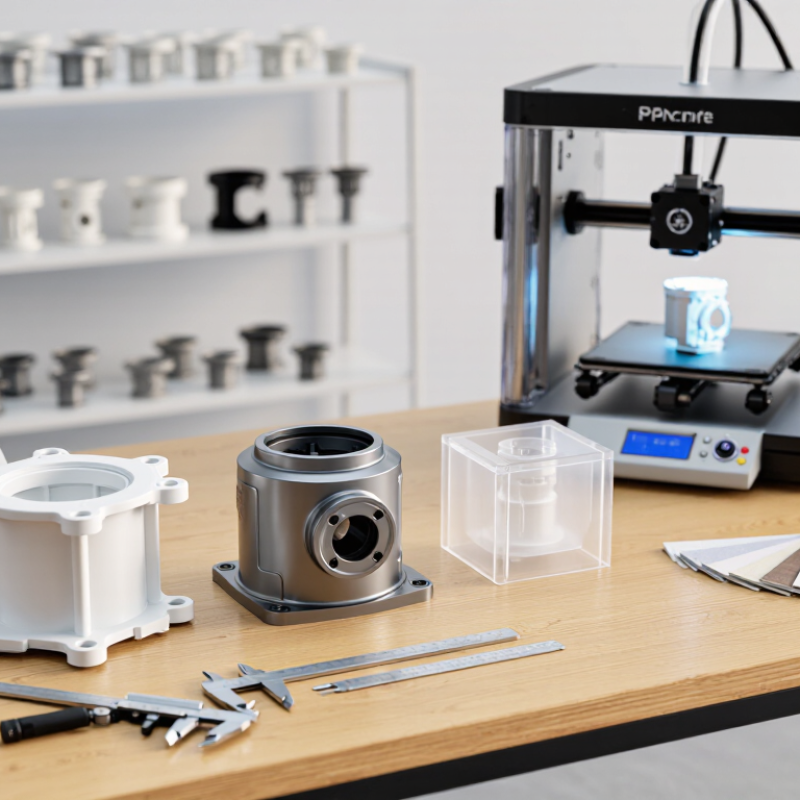
How to Choose the Best 3D Printing Service?

Define Part Requirements Using ISO/ASTM 52900 Process Categories

ISO/ASTM 52900 groups additive manufacturing into seven process categories. These names describe how a part is built, not a simple ranking of quality. Start with the part’s job. Will it carry a load, show a visible surface, resist heat, or fit against another component? Small details matter. A 2 mm wall, a snap-fit tab, and a smooth curved housing may point toward different processes.

Material extrusion deposits material through a nozzle, while vat photopolymerization cures liquid resin with light. Powder bed fusion uses energy to fuse regions of a powder bed; binder jetting joins powder with a binding agent. The other categories are material jetting, sheet lamination, and directed energy deposition.

Ask which exact process and materials a service proposes. Category labels alone cannot confirm strength, accuracy, or finish.

Share critical dimensions, tolerances, operating temperature, expected quantity, and acceptable surface roughness. Ask how build orientation, support removal, curing, or machining could affect the result. Request a sample or small test build when fit is critical. That takes time. It may prevent a costly redesign. A neat quote can still hide assumptions about thin walls or finishing, so compare written recommendations with your drawing and intended use.

Match Accuracy Needs to ISO/ASTM 52902 Capability-Test Data

When choosing a 3D printing service, define the part’s critical dimensions before comparing quotes. ISO/ASTM 52902:2019 describes geometric capability testing with standardized artifacts and dimensional measurements. Ask for the actual test results, not just a claimed tolerance. That matters.

Check which machine, material, orientation, and build position produced the data. A small hole near a build-plate edge may behave differently from a broad wall near the center. Compare measured deviations and feature limits with your drawing, then ask whether the test setup matches your part. A capability result is not a blanket guarantee. The comparison is imperfect.

Wohlers Report 2024 puts 2023 global additive manufacturing revenue at about $20.0 billion, up 11.1 percent. That growth signals a broadening service market, not uniform accuracy. Useful, but incomplete. Request a sample inspection report showing measurement method, sample count, and uncertainty where available. If a mating feature needs tight control, ask how it will be checked after printing and whether machining is included. A neat chart can still mislead when its process conditions differ from yours.

Compare Materials Using Verified Strength and Temperature Specifications

When comparing 3D printing services, ask for material test data, not just labels such as “strong” or “heat resistant.” ASTM D638 measures plastic tensile strength, while ASTM D648 measures heat deflection temperature under a specified load. Those test conditions matter. A PA12 powder-bed-fusion part may show tensile strength around 45–50 MPa and heat deflection near 90–100°C at 1.8 MPa, depending on the supplier’s test method and build direction. Treat these as typical ranges, not guarantees.

Request the exact material grade, test standard, specimen orientation, and post-processing details.

A number without those details can mislead. Parts printed in different orientations may perform differently, and heat resistance is not the same as a safe continuous-use temperature. I still find this easy to overlook when comparing quotes.

Ask whether the service can provide a technical data sheet or test report for the specific process. The Wohlers Report 2024 estimated the additive manufacturing industry reached $20.0 billion in 2023, underscoring how broad the service landscape has become. More choice means checking evidence carefully. Compare the same metrics across providers, and match them to your part’s actual load and operating temperature.

Assess Supplier Quality Systems Against ISO/ASTM 52920:2023

How to Choose the Best 3D Printing Service?

ISO/ASTM 52920:2023 sets qualification principles and requirements for industrial additive manufacturing processes and production sites. Use it as a practical benchmark when reviewing a supplier’s quality systems, not as a shortcut for judging every part. Ask how the supplier controls build files, material batches, machine settings, and post-processing. Can they trace a finished component back to its powder lot and build record? Request sample records, inspection results, and explanations of how process changes are approved. A tidy audit folder can still hide weak shop-floor habits.

Tips: Ask to see a real production traveler, with sensitive details removed. Check whether operators follow documented procedures and whether calibration records are current. Confirm that inspection methods match your part’s critical features. Small gaps matter.

Also discuss how the supplier handles nonconforming builds, corrective actions, and repeat production. A useful review connects documented procedures to evidence from the actual production site. For example, compare a stated temperature-control procedure with machine logs from a recent build. Check whether the supplier defines acceptance criteria before printing, rather than after seeing the results. The standard does not automatically prove that a specific part suits your application; you still need agreed specifications and appropriate validation. I would not treat a checklist as the whole assessment. Ask direct questions, examine representative records, and note what remains uncertain before placing an order.

How to Choose the Best 3D Printing Service?

Example supplier quality-system review aligned with topics addressed by ISO/ASTM 52920:2023. Scores are illustrative, not actual supplier results or certification thresholds.

How to read: Each area is scored from 0 (no evidence reviewed) to 5 (strong, documented evidence reviewed). Use the chart as a comparison checklist, then verify applicable requirements, records, and process controls directly with each supplier.

Compare Quotes in the $20.0 Billion 2023 AM Market (Wohlers Report 2024)

Wohlers Report 2024 estimates that the additive manufacturing industry reached $20.035 billion in 2023, growing 11.1% from 2022. That figure covers a broad ecosystem, including equipment, materials, software, and services; it is not a price list for printed parts. Still, it signals a large, expanding supplier market. Compare quotes carefully. A low headline price may exclude support removal, machining, finishing, inspection, or shipping.

Send each provider the same CAD file and written specifications. State the material, quantity, critical dimensions, tolerances, surface finish, and delivery date. Ask for a line-item quote, production method, and inspection details. For example, a small polymer bracket may need little finishing, while a metal housing with tight holes can require machining and extra checks. Those steps change the final cost. Check whether setup fees and minimum order charges apply, too.

Use the market figure as context, not proof that every supplier offers equal quality or capacity. A quote is only as reliable as its assumptions. I’d compare total delivered cost and documented capabilities, not just the first number. Some specifications may still be unclear. Resolve them before ordering, since a missing tolerance can make two quotes look comparable when they are not.