Top 10 Professional 3D Printers for Quality and Precision in 2023

The landscape of additive manufacturing has evolved dramatically in recent years, positioning professional 3D printers as critical tools across various industries. In 2023, the global 3D printing market is anticipated to reach approximately $34.8 billion, reflecting a compound annual growth rate (CAGR) of around 25.76% from 2021 to 2028. This surge underscores the growing reliance on professional 3D printers for producing high-quality prototypes, complex geometries, and customized solutions. As businesses seek to enhance their manufacturing processes and reduce time-to-market, the demand for precision and reliability in professional 3D printers has never been greater.

Technological advancements have significantly improved the capabilities of professional 3D printers, enabling them to deliver consistent results in various applications, from aerospace to healthcare. A recent report indicated that 62% of manufacturers consider 3D printing integral to their operational strategy, showcasing its influence on innovation and efficiency. The emergence of advanced materials and sophisticated printing techniques further empowers professionals to push the boundaries of design and functionality. As we delve into the top 10 professional 3D printers for 2023, it's essential to understand the features that set these devices apart and how they cater to the diverse demands of a rapidly evolving sector.

Top 10 Professional 3D Printers for Quality and Precision in 2023

Overview of Professional 3D Printing Technology in 2023
Top 10 Professional 3D Printers for Quality and Precision in 2023

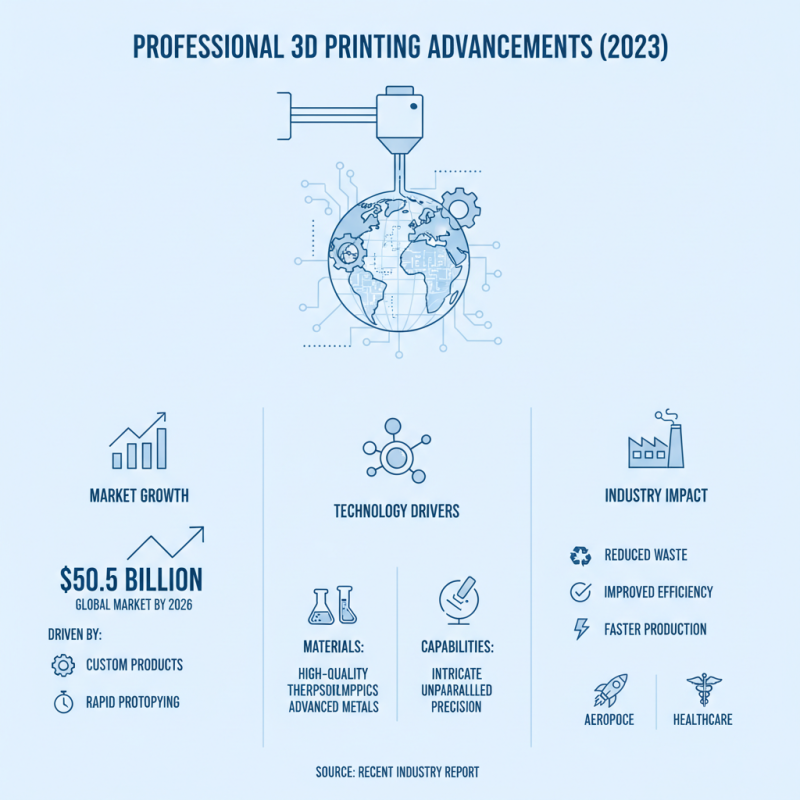
In 2023, professional 3D printing technology continues to advance, offering robust solutions for industries ranging from aerospace to healthcare. A recent industry report indicates that the global 3D printing market is projected to reach $50.5 billion by 2026, driven by increasing demands for customized products and the need for rapid prototyping. This growth is attributed to advancements in materials, including higher quality thermoplastics and metals, which enable printers to create intricate designs with unparalleled precision. Professionals are turning to additive manufacturing techniques not only for their speed but also for their ability to reduce material waste and improve manufacturing efficiency.

The precision of modern 3D printers has reached new heights, with resolutions often measured in microns, allowing for the production of highly detailed components that meet the stringent requirements of various sectors. According to the Wohlers Report 2023, about 56% of surveyed companies have adopted 3D printing for functional end-use parts, highlighting the technology's shift from prototyping to actual production. This trend signifies a maturation in 3D printing processes, where reliability and repeatability in manufacturing are no longer a concern. The integration of artificial intelligence and machine learning into 3D printing systems is further enhancing their capabilities, paving the way for smarter and more automated production processes.
Key Features to Consider When Choosing a 3D Printer

When selecting a professional 3D printer, several key features should be taken into account to ensure quality and precision. First and foremost, print resolution is crucial; a printer’s layer height directly impacts the detail and smoothness of the final product. Look for printers that offer a range of resolutions, allowing for flexibility depending on the requirements of different projects. Additionally, consider the build volume, as this determines the size of the objects you can create. A larger build area can enable the production of more complex designs without needing to combine multiple parts.

Another important aspect to evaluate is the material compatibility. A versatile 3D printer should support a variety of filaments and resins, enabling you to choose the best material for specific applications, whether it’s for strength, flexibility, or aesthetic quality. Furthermore, ease of use and software compatibility cannot be overlooked. User-friendly interfaces and powerful slicing software make for a seamless design-to-print workflow, enhancing productivity. Lastly, maintaining the printer is essential for consistent performance; features like automated bed leveling and robust support for maintenance can significantly extend the printer's lifespan and reliability.

Top 10 Professional 3D Printers with Detailed Specifications

Top 10 Professional 3D Printers for Quality and Precision in 2023

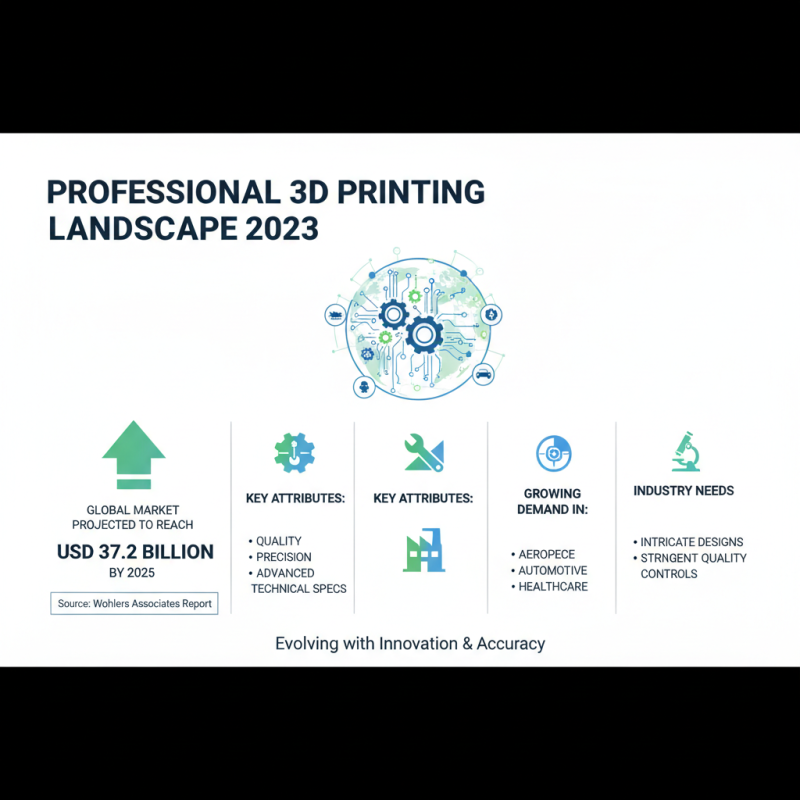
In 2023, the landscape of professional 3D printing continues to evolve, showcasing machines that balance quality, precision, and advanced technical specifications. According to a recent industry report by Wohlers Associates, the global 3D printing market is projected to reach USD 37.2 billion by 2025, highlighting the increasing demand for high-performing printers across various industries, including aerospace, automotive, and healthcare. These sectors require 3D printers that not only produce intricate designs but also maintain stringent quality controls.

When delving into the specifications of the top professional 3D printers, several key features stand out. High-resolution printers typically utilize advanced layer resolution capabilities, often reaching as fine as 20 microns, which is crucial for producing detailed prototypes and complex geometries. Furthermore, the build volume varies significantly, ranging from compact units suitable for small parts to larger models capable of creating sizable components, with some offering a build volume exceeding 1 meter cubed. Material versatility is another critical specification; these printers can handle various materials, including thermoplastics, metals, and even bio-materials, accommodating the diverse needs of engineers and designers alike. Such specifications not only meet industry demands for precision but also open up innovative possibilities in product development and manufacturing processes.

Comparison of Printing Quality Among the Top Models

When evaluating the printing quality among the top professional 3D printers, several key factors must be considered, such as layer resolution, accuracy, and material compatibility. High-end models often feature advanced technologies, allowing for finer layer heights and smoother surface finishes. This capability ensures that intricate details are reproduced with exceptional fidelity, making them ideal for applications in industries like aerospace, automotive, and healthcare where precision is paramount.

Moreover, the calibration and software algorithms play a significant role in achieving superior print quality. Printers that offer intuitive interfaces and robust support for various file types can significantly enhance the user experience while minimizing the risk of errors. Additionally, the ability to select from a wide range of materials can affect the final output’s mechanical properties and aesthetic appeal. By analyzing these parameters, professionals can better assess which printer meets their specific needs for quality and precision in their projects.

Top 10 Professional 3D Printers for Quality and Precision in 2023

Future Trends in 3D Printing Technology for Professionals

As 3D printing technology continues to evolve, several trends are shaping the future in the professional space. One key trend is the growing integration of artificial intelligence and machine learning into 3D printing processes. These technologies enable printers to become smarter, optimizing each print based on real-time data and feedback. This not only enhances precision and quality but also allows for predictive maintenance, reducing downtime and operational costs for professionals.

Another significant trend is the push towards sustainability. The development of biodegradable materials and recycling initiatives is becoming increasingly important. Professionals are exploring eco-friendly filaments that reduce waste and carbon footprints. In addition, advancements in multi-material printing allow for the creation of complex parts that combine functionalities, further promoting efficient use of resources and minimizing material waste during the production process. These shifts highlight a commitment to both innovation and environmental responsibility, key considerations for the future of professional 3D printing.

Top 10 Professional 3D Printers for Quality and Precision in 2023

Model Build Volume (mm) Layer Height (µm) Print Speed (mm/s) Material Compatibility Average Price (USD)
Model A 300 x 300 x 400 50 150 PLA, ABS, PETG 2,500
Model B 250 x 250 x 300 20 100 Nylon, TPU 3,000
Model C 400 x 400 x 500 100 200 Resin 4,500
Model D 500 x 500 x 600 75 250 PETG, ASA 3,500
Model E 300 x 300 x 200 25 80 PLA, PETG 1,800
Model F 700 x 700 x 800 50 300 Polycarbonate 6,000
Model G 350 x 350 x 400 25 90 HIPS, PVA 2,200
Model H 600 x 600 x 700 50 150 Polypropylene 5,200
Model I 450 x 450 x 500 30 120 Woodfill, Metalfill 3,800
Model J 300 x 300 x 250 10 200 Flexible Filaments 1,500