
China Top Stainless Steel Powder Manufacturers?
China has become an important source of metal powders, but choosing among its suppliers takes more than comparing prices. This guide to China’s top Stainless Steel Powder manufacturers explains what buyers should check before requesting a quote. Stainless Steel Powder is used in processes such as metal injection molding, additive manufacturing, and powder metallurgy. Each application can require different particle sizes, shapes, flow behavior, and chemical composition.
A manufacturer’s product sheet is only a starting point. Ask for recent test data covering particle-size distribution, oxygen content, apparent density, and batch consistency. Check whether the company produces the powder itself or sources it from another supplier. That distinction matters. Review quality-control procedures, available grades, sample options, production capacity, and export experience. A prompt, detailed answer can reveal as much as a polished catalog. Still, one sample cannot prove long-term consistency.
This overview is intended to help buyers compare suppliers using practical, verifiable criteria rather than broad claims. It also considers communication, documentation, and the ability to match powder specifications to real production needs. No single manufacturer is right for every application. Even a careful shortlist may overlook differences in equipment or quality systems. That limitation is worth admitting. Buyers should confirm current specifications directly, test samples under their own process conditions, and clarify packaging and delivery expectations before placing a large order.
What Is Stainless Steel Powder and How Is It Produced?
Stainless steel powder is made of fine particles containing iron, chromium, and usually nickel. Its corrosion resistance comes from the alloy, while particle size and shape affect how the powder flows and packs. Tiny details matter. Spherical particles often flow more evenly; irregular particles can interlock and pack differently. According to worldstainless’ 2023 production report, global stainless steel melt-shop output reached 58.4 million tonnes that year. That figure measures bulk steel, not powder production. The distinction is easy to blur.
Production commonly begins by melting a carefully specified stainless alloy. In gas atomization, a high-pressure gas stream breaks molten metal into droplets, which cool into powder. Water atomization uses water jets and often produces less spherical particles. The route influences flow, packing, and surface condition. It is not a cosmetic choice. Manufacturers then screen and classify the powder by particle size, while checking its chemistry and oxygen content. ASTM B214 provides a sieve-analysis method for metal powders. In practice, test results can vary with sampling and handling, so a single size number rarely tells the whole story. For powder intended for metal additive manufacturing, consistency between batches is just as important as a neat particle-size specification.
How China's Stainless Steel Powder Industry Is Organized
China’s stainless steel powder industry is organized around several linked roles. Some producers make powder through water or gas atomization, while others focus on screening, blending, or surface treatment. Their customers include manufacturers of metal-injection-molded parts, additive-manufacturing components, and thermal-spray coatings. The market is not perfectly tidy: one supplier may control several steps, while another specializes in a narrow particle-size range. That distinction matters.
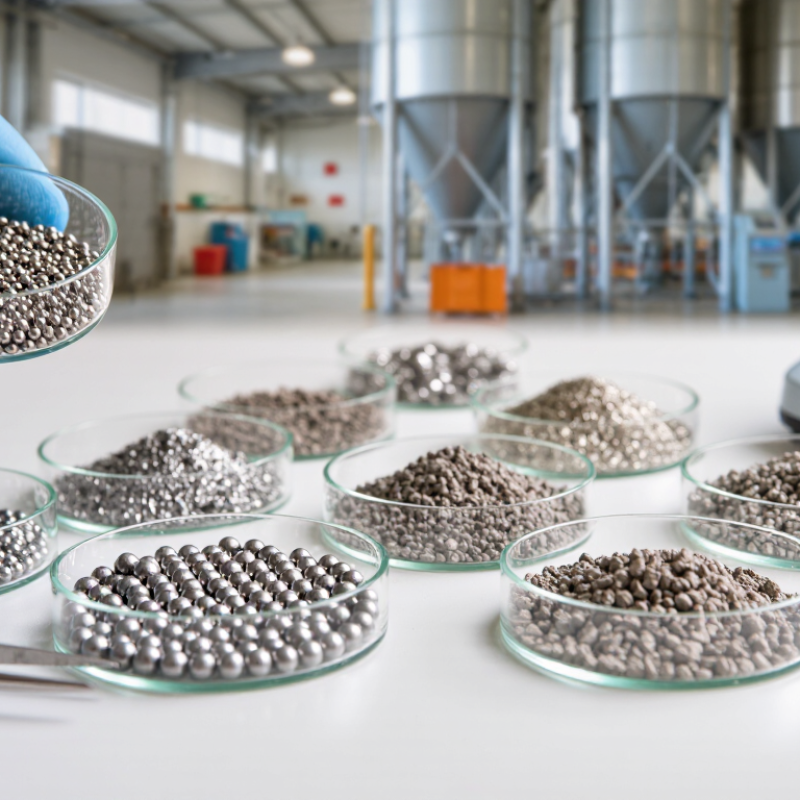
Production quality depends on more than a chemistry sheet. Buyers often compare particle-size distribution, flow behavior, apparent density, and oxygen levels, then check whether sample results match routine batches. A lab technician may pour powder through a flow funnel or inspect a sieve stack; these small checks can reveal issues before production. Regional supply networks connect powder makers with alloy feedstock providers, testing services, and component factories. Still, public information about capacity and process details can be limited, so claims deserve careful verification.
Tips: Ask for a current technical data sheet and a representative sample. Confirm the intended process, particle-size range, packaging, and batch traceability. Small differences in flow or density can affect filling and final-part consistency. And samples are not the whole story; repeatability matters.
Which Types of Stainless Steel Powder Do Chinese Manufacturers Offer?
Chinese manufacturers offer several stainless steel powder types, shaped by production method and intended use. Gas-atomized powder is usually rounded, with good flow through a narrow feeder or printer hopper. It is commonly selected for additive manufacturing and other processes that need consistent powder spreading. Water-atomized powder tends to have more irregular particles. That shape can help particles pack tightly in some powder metallurgy applications, though flow may be less smooth. Details matter. Some suppliers also offer carbonyl or specially processed powders, but availability and specifications vary.
Common alloy options include 304L and 316L austenitic powders, martensitic grades such as 17-4PH, and ferritic or heat-resistant variants. Metal injection molding often calls for fine particles and a controlled size distribution, while additive manufacturing may require spherical powder with a specified range. The same grade name does not guarantee identical performance. Ask for particle-size data, oxygen content, apparent density, and a recent batch test report. A datasheet is useful, but it may not show how powder behaves in your actual equipment. Testing a small sample can reveal gaps before production begins.
China Top Stainless Steel Powder Manufacturers? – Which Types of Stainless Steel Powder Do Chinese Manufacturers Offer?
Chinese suppliers commonly offer stainless steel powders in several alloy families and particle-size ranges. The grades and specifications below are representative; actual composition, powder characteristics, and availability vary by producer and product standard.
| Stainless Steel Powder Type | Typical Composition or Key Elements (wt.%) | Common Powder Production Routes | Typical Characteristics | Common Applications |
|---|---|---|---|---|
| Austenitic 304L | Typically 18–20% chromium and 8–12% nickel; carbon is generally limited to 0.03% maximum in standard 304L specifications. | Water atomization or gas atomization; specialized spherical powders may also be produced using other atomization methods. | General-purpose corrosion resistance, good formability, and non-magnetic or weakly magnetic behavior in the annealed condition. | Powder metallurgy components, filtration products, metal injection molding, and selected additive manufacturing applications. |
| Austenitic 316L | Typically 16–18% chromium, 10–14% nickel, and 2–3% molybdenum; carbon is generally limited to 0.03% maximum. | Water atomization and gas atomization; gas-atomized spherical grades are used where flow and packing behavior are important. | Molybdenum improves resistance to pitting and crevice corrosion compared with many standard 304-grade products. | Chemical-processing components, marine-related parts, medical devices, and metal additive manufacturing. |
| Ferritic 430L | Typically about 16–18% chromium with low carbon; nickel is generally absent or present only in small residual amounts. | Water atomization and gas atomization, depending on the required particle shape and end use. | Chromium-based corrosion resistance, magnetic behavior, and lower nickel content than common austenitic grades. | Sintered components, automotive parts, appliance components, and magnetic powder metallurgy products. |
| Martensitic 410 | Typically about 11.5–13.5% chromium, with carbon content higher than in low-carbon austenitic grades. | Water atomization or gas atomization, followed by suitable processing for the intended powder application. | Can be hardened by heat treatment; offers a balance of strength, hardness, and moderate corrosion resistance. | Wear-resistant components, valves, pump parts, and other sintered or powder-processed engineering parts. |
| Precipitation-Hardening 17-4 PH | Typically about 15–17.5% chromium, 3–5% nickel, and 3–5% copper, with niobium (columbium) additions. | Usually gas atomization for spherical powder intended for additive manufacturing or other applications requiring controlled powder flow. | Can achieve high strength through solution treatment and aging; properties depend on the heat-treatment condition. | High-strength aerospace, energy, tooling, and industrial components made by additive manufacturing or powder processing. |
| Duplex 2205 | Typically about 22–23% chromium, 4.5–6.5% nickel, 3–3.5% molybdenum, and nitrogen additions. | Gas atomization is commonly used for spherical grades; other routes depend on the intended powder application. | Duplex austenitic-ferritic alloy family known for strength and resistance to localized corrosion; powder properties depend on processing and final heat treatment. | Corrosion-resistant industrial components, energy-sector parts, and specialized additive manufacturing applications. |
| Custom or Application-Specific Stainless Steel Powder | May include modified versions of established stainless steel grades or compositions developed for specific processing requirements. | Atomization route and particle-size distribution are selected according to the target process and component design. | Specifications may cover particle size, apparent density, flowability, oxygen content, morphology, and chemical composition. | Metal injection molding, sintering, thermal spraying, filtration, and metal additive manufacturing. |
How to Compare Stainless Steel Powder Manufacturers in China
Comparing stainless steel powder manufacturers in China starts with the powder, not the catalogue. Request a recent batch sample and check particle-size distribution, apparent density, flow rate, and oxygen content against your process needs. A laser diffraction chart is useful, but ask how the sample was prepared and which test method was used. Small differences can affect filling, sintering, or additive manufacturing. No supplier is perfect. Look for clear explanations when results vary, rather than polished claims alone.
Review quality records across several batches, not just one attractive certificate. Ask for traceability from atomization lot through packing, plus a certificate of analysis tied to the actual shipment. Packaging deserves attention: sealed moisture barriers and clear lot labels reduce mix-ups during storage. Check whether technical staff can discuss alloy chemistry, particle morphology, and handling limits in concrete terms. Response speed is useful, though it cannot replace evidence. If possible, run a trial using your own equipment and acceptance criteria. A supplier may look strong on price, yet inconsistent flow or broad size variation can raise production costs. Compare lead times, minimum order quantities, complaint handling, and change-control practices before deciding. Leave room for uncertainty; one test rarely tells the whole story.
What Quality Standards and Applications Should Buyers Consider?
Choosing stainless steel powder starts with the manufacturing process, not just an alloy label. For laser powder-bed fusion, buyers commonly assess particle shape, size distribution, satellite particles, and flow. Metal injection molding may require finer particles and consistent packing behavior. A powder can look uniform under a desk lamp yet segregate during handling. Small detail. Confirm chemistry against the required grade, including chromium, nickel, molybdenum, carbon, and controlled impurities.
Ask for a lot-specific certificate of analysis and clear test methods. Check particle-size distribution, oxygen and nitrogen levels, moisture, morphology, apparent density, and flow rate. Align acceptance limits with recognized ASTM or ISO methods where applicable, and agree on the exact method with the supplier. That matters. Traceability between the test report, production lot, and sealed package helps when results differ. A certificate alone does not prove reliable performance in your equipment.
Match testing to the finished application. In additive manufacturing, validate powder reuse, build consistency, and mechanical properties after the specified heat treatment. For injection molding, review feedstock behavior, shrinkage, and sintered-part density. Corrosion resistance should be tested in conditions resembling actual service, not assumed from a grade name. No single test tells the whole story. Trial runs take time, and they can expose gaps in a specification that looked complete on paper.