Why Choose a Tennis Stringing Machine for Your Business?
For a tennis shop, a Tennis Stringing Machine is more than a piece of equipment. It can bring stringing in-house, shorten turnaround, and give staff better control over each job. A player may arrive with a snapped poly string before league night, hoping to collect the racquet tomorrow. Reliable capacity matters. So does repeatability. A consistent pull, secure mounting, and careful technique help reduce avoidable variation between racquets. The machine does not replace a skilled stringer, though. Not even close.
Racquet technician Ron Yu offers a useful principle: “The best setup is the one that matches the player.” That idea shapes the business case. A machine makes sense when local demand, labor time, and service quality support the investment. Shops should compare tensioning systems, clamps, maintenance needs, warranty terms, and training requirements before buying. Then track actual jobs and turnaround times. Numbers can surprise you. A busy-looking counter may not mean enough paid stringing work to cover a costly upgrade. And a cheaper machine can become frustrating if it slows staff or needs frequent adjustment. There is no perfect choice. For a business serving club players, schools, or frequent competitors, the right Tennis Stringing Machine can improve service and create a dependable revenue stream—but only when sound workflow and honest demand are already there.
What a Tennis Stringing Machine Does
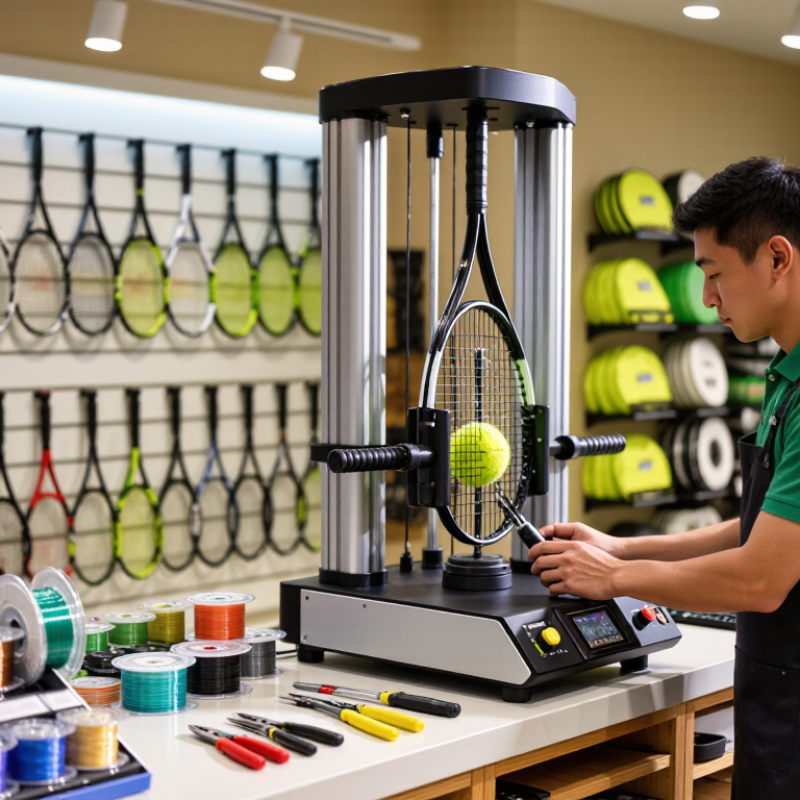
A tennis stringing machine secures a racket and helps guide string through its frame. Mounting supports hold the racket steady, while clamps keep completed sections from slipping. The tensioning mechanism pulls each string to a selected setting. This helps create a more even string bed across the racket.
The process is controlled, but not automatic from start to finish. The stringer still chooses a suitable tension, threads the string through each grommet, and checks the pattern. Small mistakes matter. A loose clamp or poorly mounted frame can affect the result, even when the tension display looks correct. A machine cannot fix a poor setup.
For a business, repeatability can make daily work easier. Staff can follow the same steps, record a customer’s preferred setup, and prepare rackets with less guesswork. Electronic models may maintain tension as the string stretches, while manual models rely more on the operator’s technique. Either way, regular checks help confirm that the machine is pulling accurately. That part is easy to underestimate. The machine supports skilled work; it does not replace careful handling or informed judgment.
How Stringing Services Fit Into a Tennis Business
Stringing services give a tennis shop, club, or coaching facility a practical reason to serve players between lessons and match days. The USTA’s 2024 Tennis Participation Report counted 25.7 million U.S. tennis players, a broad customer base with different needs, from beginners replacing worn strings to competitive players testing tension. A machine lets a business handle these requests on-site, rather than sending customers elsewhere. Demand is uneven, though. A busy tournament week can be followed by quiet days, so service volume should be tracked before investing in extra capacity.
A stringing service also creates useful conversations. Ask about playing frequency, preferred feel, and recent discomfort, then record the player’s string type and tension for the next visit. These details help staff make consistent recommendations without promising that equipment will prevent injury or improve results.
A visible service counter, clear turnaround estimates, and a simple booking process make the offer easier to use. Keep the workflow realistic: rushed work can damage trust, and one machine may become a bottleneck during league season.
Tips: Start with a service log. Note frame, string, tension, completion time, and customer feedback. Review it monthly; the pattern may surprise you. Keep records.
Business Benefits of Offering In-House Stringing
Offering in-house stringing gives a tennis shop a useful service beyond selling racquets, shoes, and balls. A player can drop off a racquet after work and collect it before a weekend match. Less waiting. This convenience may encourage repeat visits, especially when staff record each customer’s preferred string, tension, and service date. A simple service log helps avoid guesswork next time.
In-house work also gives staff more control over turnaround times and quality checks. They can inspect grommets, note frame condition, and confirm tension before starting. These details build trust. Track string, labor, and machine costs against actual job volume; a machine does not pay for itself just because it looks professional. Slow weeks happen. Shops may need appointments or several trained staff members to keep the service running smoothly.
Stringing can also create natural conversations about feel, durability, and playing habits without pushing the most expensive option. Ask how often the customer plays and what they notice during a match. Keep recommendations measured: tension preferences are personal, and one setup may feel harsh to another player. A visible work area, clean clamps, and clear pickup times help the service feel dependable, though delays can still happen during busy periods.
Why Choose a Tennis Stringing Machine for Your Business? - Business Benefits of Offering In-House Stringing
| Business metric | Illustrative in-house model | Illustrative outsourced model | Potential business benefit |
| Customer price per racquet | $30 | $30 | Keeps the example customer price consistent for comparison. |
| Direct service cost per racquet | $12: $6 materials plus $6 labor | $18 assumed service fee | In-house service may reduce the per-job cost when labor and material costs are controlled. |
| Contribution per racquet | $18 | $12 | Illustrative increase of $6 per job before other overheads. |
| Monthly stringing jobs | 50 assumed jobs | 50 assumed jobs | Use actual shop demand to estimate the financial impact. |
| Illustrative monthly contribution | $900 | $600 | Potential $300 monthly difference at the assumed volume and costs. |
| Example machine investment | $1,800 assumed purchase cost | No machine purchase assumed | Compare equipment cost with expected job volume and contribution. |
| Simple payback estimate | About 6 months | Not applicable | Based on the $300 monthly difference; excludes maintenance, financing, taxes, and changes in demand. |
| Service control and customer experience | Manage scheduling, turnaround, and quality checks in-house. | Turnaround and workflow depend partly on an external provider. | In-house stringing can make it easier to coordinate service with retail visits and customer preferences. |
Note: All figures are illustrative planning assumptions, not industry averages or guaranteed results. The model assumes a $30 customer charge, $6 in materials, 20 minutes of labor at $18 per hour, an $18 outsourcing fee, 50 jobs per month, and a $1,800 machine cost. Actual costs, pricing, workload, and payback will vary by business.
Types of Tennis Stringing Machines and Their Features
Why Choose a Tennis Stringing Machine for Your Business?
Tennis Stringing Machines and Their Features
A tennis stringing machine affects turnaround time, tension consistency, and the kinds of jobs a shop can accept. Drop-weight models use gravity to pull tension. They are mechanically simple and often suit low-volume work, but the arm must settle level each time. Small setup differences can matter.
Spring-based crank machines pull tension quickly, then lock when the set tension is reached. They can handle regular shop use, though the string may lose a little tension as it stretches after locking. Electronic constant-pull machines keep adjusting during the pull, which can improve consistency with responsive strings. Many offer adjustable speed and tension settings, but they need power and routine calibration. More features do not automatically mean better service. I have seen a busy workflow make even a capable machine feel cumbersome.
Tips: Match the machine to your daily racket count and available bench space. Check the calibration with a tension tester, inspect clamps for slippage, and keep the turntable clean. Record settings for repeat customers. It sounds basic, but rushed clamping is an easy mistake to make. A short trial session can reveal whether the controls and mounting system suit your staff.
Costs, Workflow, and Maintenance Considerations
A tennis stringing machine can help a shop offer faster, more predictable service, especially when restringing requests arrive daily. The purchase price is only part of the cost. Include installation, tools, staff training, and occasional calibration in your budget. Small costs add up. Before buying, compare expected jobs per week with the time currently spent outsourcing or completing each restring. A busy shop may benefit quickly, while a quieter one could leave the machine underused. That is worth considering.
Tips: Track restringing volume for several weeks before choosing a machine. Keep a simple log of labor time, string types, and repeat adjustments. It can reveal whether the investment fits your real workload.
A clear workflow reduces delays: record the player’s requested tension, inspect the frame, string it, then check the finished job. Assigning one person to intake and another to stringing may help during busy periods, but only if communication stays clear. Small errors happen. Keep clamps and rails free of dust, check moving parts regularly, and follow the manufacturer’s calibration guidance. Tension can drift over time, so periodic checks matter. Maintenance takes staff time; forgetting to budget for it can make a useful machine feel like an extra burden.
Why Choose a Tennis Stringing Machine for Your Business?
Illustrative annual cost comparison for 300 restring jobs. In this example, outsourcing costs $30 per job; in-house estimates assume a $1,500 machine amortized over three years, 20 minutes of labor per job at $20 per hour, and $150 annual maintenance. String costs are excluded from both options.
Under these assumptions, outsourcing totals $9,000 per year, while in-house stringing totals $2,650, including labor, annualized machine cost, and maintenance. Actual costs and workflow times vary by location, equipment, and business volume.