What Are the Top 10 3D Printing Manufacturers in China?

China’s 3D Printing sector spans desktop machines, industrial polymer systems, and metal-production equipment. A useful manufacturer comparison must look beyond headline speed. Buyers should examine materials, build volume, repeatability, service support, and the parts they actually need to make.

The 2024 Wohlers Report put global additive-manufacturing industry revenue at $21.9 billion in 2023, an 11.1% increase over 2022. That growth signals expanding adoption, but it does not prove that every supplier or printer is equally capable. The stakes are real. A polished showroom sample may look impressive; consistent output across repeated production runs matters more.

Terry Wohlers, a longtime additive-manufacturing analyst, has emphasized a practical principle: choose the technology for its application, rather than treating it as a universal replacement for conventional manufacturing. This article compares ten Chinese manufacturers across product focus, technology, market reach, and customer support. Some serve industrial production; others target prototyping or accessible desktop printing. The list is a starting point, not a definitive ranking. Public information can be uneven, and specifications alone cannot confirm real-world reliability. Readers should verify current models, certifications, and service arrangements directly with each company. A careful shortlist is more useful than a bold claim.
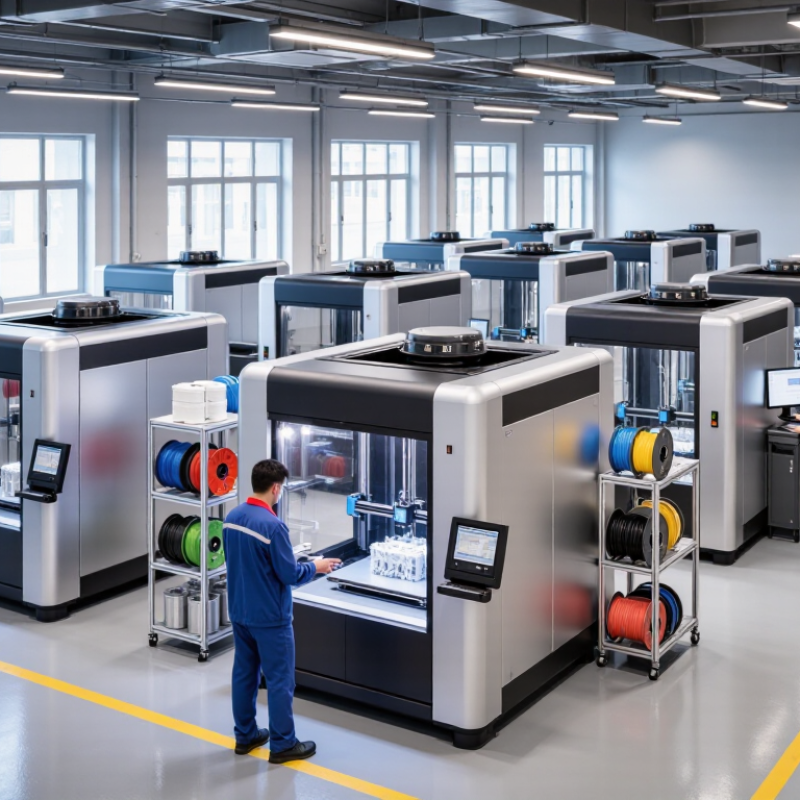
What Are the Top 10 3D Printing Manufacturers in China?

How China’s 3D Printing Industry Is Structured

China’s 3D printing industry is better understood as a connected supply chain than a list of machine makers. It includes equipment developers, material suppliers, software teams, service bureaus, and manufacturers using printed parts. Some firms specialize in printers; others earn revenue from design, prototyping, or small-batch production. The boundaries blur. Not every company fits one category.

Wohlers Report 2024 estimated that global additive manufacturing revenue reached $20.035 billion in 2023, up 11.1% from 2022. This is a worldwide figure, not a China-only market estimate, but it shows the scale of the sector these Chinese suppliers serve. Within China, the mix ranges from low-cost desktop systems to industrial machines used for metal components. Service providers can connect equipment makers with customers who lack in-house printing expertise.

The structure has weak spots. A printer’s advertised precision does not guarantee consistent parts; materials, calibration, and post-processing matter too. Buyers often need to inspect sample parts and verify repeatability before placing large orders. That takes time. It is also where a simple “top ten” ranking can mislead: a strong machine maker and a dependable production service solve different problems. Industry capability is distributed across the chain, and comparisons need to account for that.
Criteria for Ranking Chinese 3D Printing Manufacturers

What Are the Top 10 3D Printing Manufacturers in China?

Criteria for Ranking Chinese 3D Printing Manufacturers

A useful ranking should compare manufacturers against the same practical criteria, not just machine prices or production claims. Start with technical fit: check supported printing processes, build volume, layer resolution, and compatible materials. Ask whether sample parts can show the surface finish and dimensional accuracy your project requires. A large build chamber is not automatically better.

Reliability matters. Review documented quality procedures, equipment calibration, inspection records, and consistency across repeated production runs. Check whether the supplier can explain its testing methods and provide clear lead-time estimates. After-sales support, spare-part availability, and operator training also affect long-term value. Public information can be incomplete, so a polished website alone is weak evidence.

Tips: Request a sample made to your specifications, and ask how it was inspected. Compare written quotations line by line, including material, finishing, packaging, and shipping assumptions. Verify certifications directly where possible. Be cautious of broad accuracy claims without test conditions. One caveat: a strong prototype does not prove reliable high-volume production. Ask for evidence from repeat orders, and note any unanswered questions before ranking suppliers.

Criteria for Evaluating Chinese 3D Printing Manufacturers

Suggested weighting for a manufacturer comparison. These percentages are an evaluation framework, not measured company or market data.

A balanced assessment can consider technical capability, product range, quality systems, production capacity, application support, and cost. Adjust the weights to suit your project requirements.

The Top 10 3D Printing Manufacturers in China

China’s leading 3D printing manufacturers serve very different needs, so a top-ten list should not imply one universal winner. Some focus on metal parts for industrial equipment, while others specialize in polymer prototypes, dental models, or compact desktop systems. The right choice depends on the part, material, production volume, and required finish. Details matter.

Across a top-ten shortlist, compare more than machine speed. Ask about layer resolution, supported materials, build size, and repeatability across multiple production runs. Request a sample part with thin walls, small holes, and a visible overhang. Its surface can reveal details that a specification sheet may miss. A polished brochure can still hide practical limits.

Service deserves equal attention. Check whether engineers help tune print settings, explain material trade-offs, and troubleshoot failed builds. Ask for documented inspection steps and realistic lead times. If possible, test a small order before committing to regular production. This comparison is imperfect: public information can be uneven, and “best” often depends on your application. Even so, clear specifications and a physical sample make supplier claims easier to assess.

Key Technologies and Industries Served by These Manufacturers

China’s leading 3D-printing manufacturers span metal powder-bed fusion, polymer powder sintering, vat photopolymerization, and material extrusion. Laser powder-bed fusion builds dense metal parts layer by layer, supporting aerospace components, medical implants, and complex industrial tooling. Polymer processes produce lighter housings, prototypes, and customized components for automotive and consumer-electronics production. The fit depends on more than printer speed. Material qualification and repeatable surface quality matter.

Wohlers Report 2024 estimates global additive-manufacturing industry revenue reached US$20.0 billion in 2023, an 11.1% increase over 2022. That figure covers a broad market, not China alone. It helps explain why manufacturers offer different technology mixes rather than one universal solution. ASTM International’s process classifications also help buyers compare methods consistently. Details matter.

For production teams, the practical distinction is often part size, material, and finishing workload. Metal deposition can repair or add features to existing parts, while binder jetting can suit higher-volume batches when post-processing is controlled. Medical and aerospace users need rigorous validation; tooling and automotive teams may prioritize lead time and cost. A caveat: advertised accuracy does not guarantee identical results across machines, materials, or operators. Teams should test representative parts before committing.

What Are the Top 10 3D Printing Manufacturers in China? - Key Technologies and Industries Served by These Manufacturers

Scope: This technology-based overview describes ten established 3D-printing equipment categories manufactured in China. It is not a verified ranking of individual companies; company and brand names are intentionally omitted.

No. Manufacturer Focus Key Technology Typical Materials Industries Served Common Applications
1 Metal powder-bed fusion systems Laser powder-bed fusion (LPBF), also known as selective laser melting in many product descriptions Stainless steel, titanium alloys, aluminum alloys, nickel-based alloys, and cobalt-chromium alloys Aerospace, medical, automotive, tooling, and energy Complex metal parts, lightweight components, implants, conformal-cooling inserts, and small production runs
2 Electron-beam metal powder-bed systems Electron-beam powder-bed fusion (EB-PBF) Titanium alloys and other electrically conductive metal powders suited to the process Aerospace, medical, and advanced engineering Porous orthopedic components, lattice structures, and complex titanium parts
3 Directed-energy deposition equipment Laser or other focused-energy deposition of metal powder or wire Titanium alloys, stainless steels, nickel alloys, and metal wire feedstock Aerospace, shipbuilding, energy, heavy industry, and repair services Large metal builds, feature addition, surface cladding, and repair of worn components
4 Polymer powder-bed systems Selective laser sintering (SLS) Polyamide powders, including PA12 and PA11, and selected elastomeric powders Automotive, consumer products, medical-device development, and industrial design Functional prototypes, ducts, housings, clips, and complex polymer parts without support structures
5 Resin-based photopolymerization systems Stereolithography (SLA) and digital light processing (DLP) Photopolymer resins, including standard, tough, castable, and dental formulations Dental, jewelry, consumer products, education, and product design High-detail prototypes, dental models, surgical-planning models, casting patterns, and visual models
6 Material-extrusion systems Fused filament fabrication (FFF), commonly called fused deposition modeling (FDM) PLA, ABS, PETG, TPU, polycarbonate, and selected fiber-reinforced filaments Education, research, manufacturing, architecture, and consumer-product development Concept models, jigs, fixtures, enclosures, and low-volume polymer parts
7 Metal binder-jetting systems Powder-bed binder jetting followed by curing, debinding, and sintering Stainless-steel powders and other metal powders developed for binder-jet processing Automotive, consumer goods, industrial manufacturing, and tooling Batch production of relatively small metal components and parts with complex geometries
8 Sand-mold and core printing systems Binder jetting of foundry sand Silica sand and other foundry-grade sands with compatible binders Foundries, automotive, machinery, and heavy equipment Complex casting molds and cores that can reduce the need for conventional tooling
9 Construction-scale printing systems Robotic or gantry-based extrusion of cementitious mixtures Printable cement-based and other formulated construction materials Construction, architecture, infrastructure research, and building-material development Walls, building components, architectural forms, and construction-process demonstrations
10 Ceramic additive-manufacturing systems Vat photopolymerization or paste extrusion followed by debinding and sintering Alumina, zirconia, silica-based ceramics, and formulated ceramic pastes Electronics, healthcare, aerospace, chemical processing, and research Custom ceramic geometries, technical components, prototypes, and laboratory parts

How to Compare Manufacturers for Different Needs

When comparing China’s 3D printing manufacturers, start with the part, not the machine. A supplier suited to metal aerospace components may be a poor fit for short-run polymer housings. Check material certificates, dimensional tolerances, surface finish, and inspection records. Ask for a sample made from your actual design. A smooth display piece proves little about repeatability.

Capacity and delivery matter, too. Request a written quote that separates setup, materials, finishing, inspection, and shipping. Wohlers Report 2024 estimated that the global additive manufacturing industry reached $20.0 billion in 2023, growing 11.1% from 2022. That expansion signals a broadening market, not uniform quality. Compare lead times against recent production records, and ask how rejected parts are handled. One uncomfortable point: the cheapest quote can conceal extra finishing costs—or optimistic delivery dates.

Tips: Send the same drawing and acceptance criteria to each candidate. Ask for a first-article inspection report, material traceability, and a clear revision-control process. For prototypes, prioritize speed and design feedback. For production, weigh repeatability, documented quality checks, and capacity. Keep a small pilot order before scaling; it adds time, but skipping it can be costlier.